Wayne County Dog Registration Information
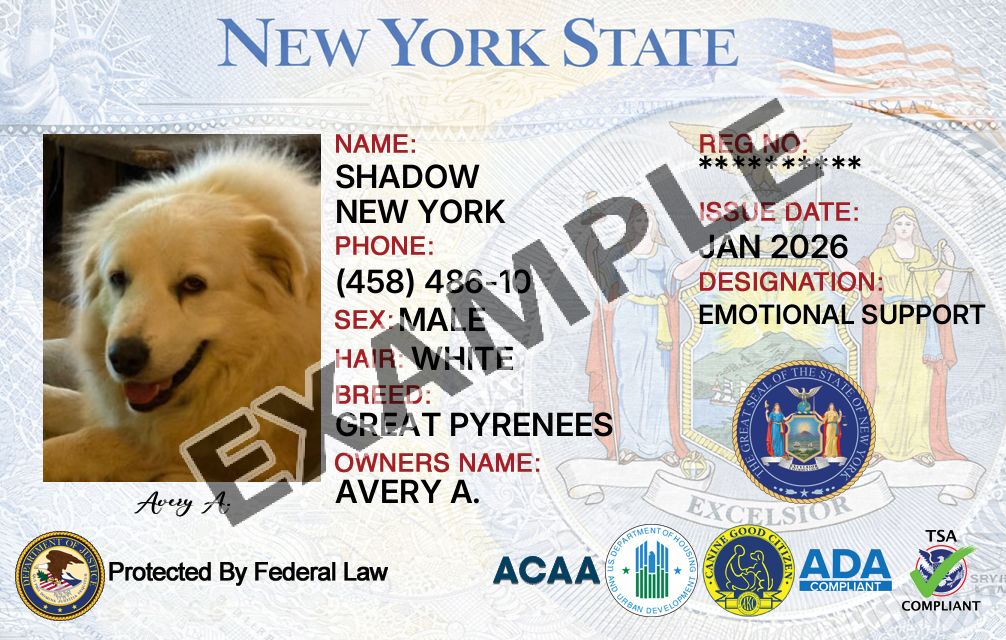
Service Dogs and Emotional Support Animals in Wayne, New York
Where Do I Register My Dog in Wayne County, New York for My Service Dog or Emotional Support Dog?
In Wayne County, New York, “registering your dog” usually means getting a local dog license through the town or village clerk where you live. Even if your dog is a service dog or an emotional support animal (ESA), local dog licensing rules can still apply. This page explains how a dog license in Wayne County, New York typically works, what you’ll need, and how licensing is different from service dog or ESA status under the law.
Where to Register or License Your Dog in Wayne County, New York
In Wayne County, dog licensing is commonly handled by the clerk’s office in your town or village. Some residents live in a village within a town (for example, Village of Newark within the Town of Arcadia area). If you are unsure which clerk issues your license, call the closest clerk’s office for guidance and confirm which municipality should process your dog license.
Town of Lyons — Town Clerk’s Office
- Phone: (315) 946-6252 ext. 101
- Email: townclerk@lyonsny.gov
- Hours: Monday–Thursday: 8:00 AM–4:00 PM; Friday: 8:00 AM–2:00 PM (2:00 PM–4:00 PM by appointment only)
Town of Sodus — Town Clerk’s Office
- Phone: (315) 483-6934 ext. 1
- Email: townclerk@sodusny.gov
- Hours: Monday–Friday: 9:00 AM–5:00 PM
Village of Newark — Village Office (Dog Licenses)
- Phone: (315) 331-4770
- Hours: Monday–Friday: 8:00 AM–4:30 PM
Overview of Dog Licensing in Wayne County, New York
A local dog license is a government-issued record that connects a dog to an owner and address. In many parts of New York State, licensing is administered at the town or village level. That’s why “animal control dog license Wayne County, New York” searches often lead residents to clerk offices rather than a single countywide licensing department.
While each municipality can have its own process, dog licensing requirements in Wayne County, New York commonly include proof of current rabies vaccination, an application, and a licensing fee (fees can vary by whether a dog is spayed/neutered and by local law).
What You Need Before Registering a Dog
Before you visit (or contact) your clerk’s office, gather documentation commonly requested for a dog license in Wayne County, New York. Requirements can vary slightly by town or village, so confirm details with your local office.
Common documents and information
- Rabies vaccination certificate (required for licensing in many municipalities)
- Spay/neuter proof (if applicable, and if it impacts your fee category)
- Owner identification (driver’s license or other ID)
- Proof of residency (sometimes requested, especially if you recently moved)
- Dog details (name, breed/type, color/markings, sex, age, and microchip number if available)
Steps to Register or License a Dog in Wayne County, New York
The typical process to obtain a dog license through your municipality looks like this. Your town or village may allow in-person registration, mail-in licensing, and/or renewal options.
- Identify your licensing municipality. Start with your town clerk, or your village office if your address is within an incorporated village that issues licenses.
- Confirm the license type and term. Ask whether the license is annual and whether multi-year options are available, if offered locally.
- Bring proof of rabies vaccination. Many licensing clerks require a current rabies certificate before issuing or renewing a license.
- Provide spay/neuter documentation (if applicable). Some municipalities set different fees based on sterilization status.
- Submit the application and pay the fee. Fees vary by municipality and dog status; ask your clerk’s office what payment types are accepted.
- Keep your tag and records. The license tag helps identify your dog if it’s found, and the license record can help confirm ownership.
Dog License vs. Service Dog vs. Emotional Support Animal (ESA)
It’s common to search “where to register a dog in Wayne County, New York” when you have a service dog or emotional support dog. The key is understanding that these are different concepts:
| Category | What it is | Who issues it | Typical proof/requirements | What it affects |
|---|---|---|---|---|
| Dog license | Local license/record connecting a dog to an owner and address | Town clerk or village office (municipality) | Often rabies certificate; application; fee; sometimes spay/neuter proof | Local compliance; identification; may support reunification if lost; may be required by local law |
| Service dog | A dog individually trained to do work or perform tasks for a person with a disability | No single universal government registry | Task training related to disability; must meet applicable local health requirements (like vaccinations and licensing) | Public access rights in many settings under disability law; not the same as a dog license |
| Emotional Support Animal (ESA) | An animal that provides emotional support that alleviates symptoms of a disability | No single universal government registry | Typically documentation from a qualified healthcare provider for specific housing-related accommodations (as applicable) | Commonly relevant to housing accommodations; ESAs are not the same as service dogs for public access |
Bottom line: a dog license in Wayne County, New York is a local government requirement that may apply to pet dogs, service dogs, and emotional support animals alike. Service dog and ESA status are determined by legal definitions and documentation/training standards—not by purchasing a registration number from a single “registry.”
Service Dog Laws in Wayne County, New York
Service dog rights generally come from disability laws and depend on the dog being trained to perform tasks or work for a person with a disability. These protections are separate from municipal licensing. In practice, you may still be asked to comply with local public health rules such as rabies vaccination and may still need a dog license where required by your municipality.
What to expect locally
- Licensing may still apply: Many municipalities license dogs regardless of whether the dog is a pet or a service dog.
- Rabies vaccination rules still matter: Local licensing commonly relies on proof of rabies vaccination.
- No “official federal registration” is required: Service dog status is not created by signing up in a single database.
- Fees may differ: Some municipalities may have different fee rules for certain working dogs; ask your local clerk what applies in your town/village.
Emotional Support Animal Rules in Wayne County, New York
An emotional support animal (ESA) is not the same as a service dog. ESAs generally do not have the same public access rights as service dogs. ESA status is most often discussed in the context of housing accommodations when a person has a disability-related need for the animal.
How ESAs relate to dog licensing
- Licensing is separate: A local dog license is still a local requirement and is not replaced by ESA documentation.
- Rabies documentation is still important: If your municipality requires proof of rabies vaccination to issue a license, ESA status does not usually remove that step.
- No single universal registry: ESA status is not established by a universal federal government registry.
Frequently Asked Questions
Is “registering my dog” the same as getting a dog license in Wayne County, New York?
In most local contexts, yes. People often use “register” and “license” interchangeably. The official process is typically called dog licensing and is handled by your town clerk or village office.
Do I need a dog license if my dog is a service dog?
Many municipalities still require local licensing for dogs, including service dogs, even though service dog status is separate from licensing. The safest approach is to contact your local clerk’s office and ask about service dog licensing fees and documentation requirements in your municipality.
Do I need a dog license if my dog is an emotional support animal (ESA)?
ESA status typically relates to housing accommodations and does not replace local dog licensing requirements. If your town or village requires a dog license, you generally still license your ESA like any other dog.
What if I live in a village inside a town?
In some parts of Wayne County, the village office may handle dog licenses for village residents; in other areas, the town clerk does. If you are unsure, call the nearest clerk’s office and confirm which office serves your address.
What documents are usually required for dog licensing requirements in Wayne County, New York?
Many offices ask for a current rabies vaccination certificate and may also request spay/neuter documentation (if it affects fees). Requirements can vary by municipality, so verify with the clerk’s office listed above for your area.
Plain-Language Summary
- Where to register a dog in Wayne County, New York: Usually your town clerk or village office (see the office cards above).
- Dog licensing requirements Wayne County, New York: Often include proof of rabies vaccination, plus an application and fee.
- Service dogs: Protected under disability law based on training and disability-related tasks; not created by a universal registry.
- Emotional support animals: Typically relevant to housing accommodations; not the same as service dogs and not created by a universal registry.
Register A Dog In Other New York Counties
Select your county below to get started with your dog’s ID card. Requirements and license designs may vary by county, so choose your location to see the correct options and complete your pup’s registration.
- Albany County Dog Registration
- Allegany County Dog Registration
- Bronx County County Dog Registration
- Broome County Dog Registration
- Cattaraugus County Dog Registration
- Cayuga County Dog Registration
- Chautauqua County Dog Registration
- Chemung County Dog Registration
- Chenago County Dog Registration
- Clinton County Dog Registration
- Columbia County Dog Registration
- consolidated borough-county government County Dog Registration
- Cortland County Dog Registration
- Delaware County Dog Registration
- Dutchess County Dog Registration
- Erie County Dog Registration
- Essex County Dog Registration
- Franklin County Dog Registration
- Fulton County Dog Registration
- Genesee County Dog Registration
- Greene County Dog Registration
- Hamilton County Dog Registration
- Herkimer County Dog Registration
- Jefferson County Dog Registration
- Kings County County Dog Registration
- Lewis County Dog Registration
- Livingston County Dog Registration
- Madison County Dog Registration
- Monroe County Dog Registration
- Montgomery County Dog Registration
- Nassau County Dog Registration
- New York County County Dog Registration
- Niagara County Dog Registration
- Oneida County Dog Registration
- Onondaga County Dog Registration
- Ontario County Dog Registration
- Orange County Dog Registration
- Orleans County Dog Registration
- Oswego County Dog Registration
- Otsego County Dog Registration
- Putnam County Dog Registration
- Queens County County Dog Registration
- Rensselaer County Dog Registration
- Richmond County Dog Registration
- Rockland County Dog Registration
- Saratoga County Dog Registration
- Schenectady County Dog Registration
- Schoharie County Dog Registration
- Schuyler County Dog Registration
- Seneca County Dog Registration
- St. Lawrence County Dog Registration
- Steuben County Dog Registration
- Suffolk County Dog Registration
- Sullivan County Dog Registration
- Tioga County Dog Registration
- Tompkins County Dog Registration
- Ulster County Dog Registration
- Warren County Dog Registration
- Washington County Dog Registration
- Westchester County Dog Registration
- Wyoming County Dog Registration
- Yates County Dog Registration